
Runs fairly well with a few issues most likely due to timing differences between the MiSTer emulated motherboard peripherals and the real IBM PC.
Month: August 2022
Osborne 1 Debug with MCLZ8
I recently purchased an Osborne 1 computer which was not able to boot but was in very good cosmetic condition so I thought it would be a good opportunity to try the my MCLZ8 on another vintage Z80 machine.

When the computer is turned on it made a continuous beeping sound, the disk drive was running non-stop, and there was random data on the screen. The first step was to open the machine and test the voltages which were all within specifications. Actually, the first-first step was to put some tape over the speaker as this beep was very loud and annoying! 🙂
Next I removed the Z80 and installed the MCLZ8 to test DRAM for any issues. I added a few lines of code to the MCLZ8 after RESET was de-asserted to write and read from the 64KB of DRAM using BIU reads and writes. I found that the first three DRAM banks were ok and that there was a stuck bit on bit[5] of the fourth bank. Here is a pic of the socketed and replaced it with a spare DRAM from my Apple II+. You can even see the Apple logo on the chip!

After that the machine was able to print to the screen! This banner was, however, flashing continuously and it took me a while to understand that it was because there was a stuck key(s) on the keyboard. When the keyboard was unplugged the flashing went away.
I used a trick I found on the web to simulate an Enter-key keypress by shorting keyboard connector pins 3 and 15 momentarily. When this was done it went into a loop reporting BOOT ERROR. Light criticism, but would have more accurate to say there was no disk present…
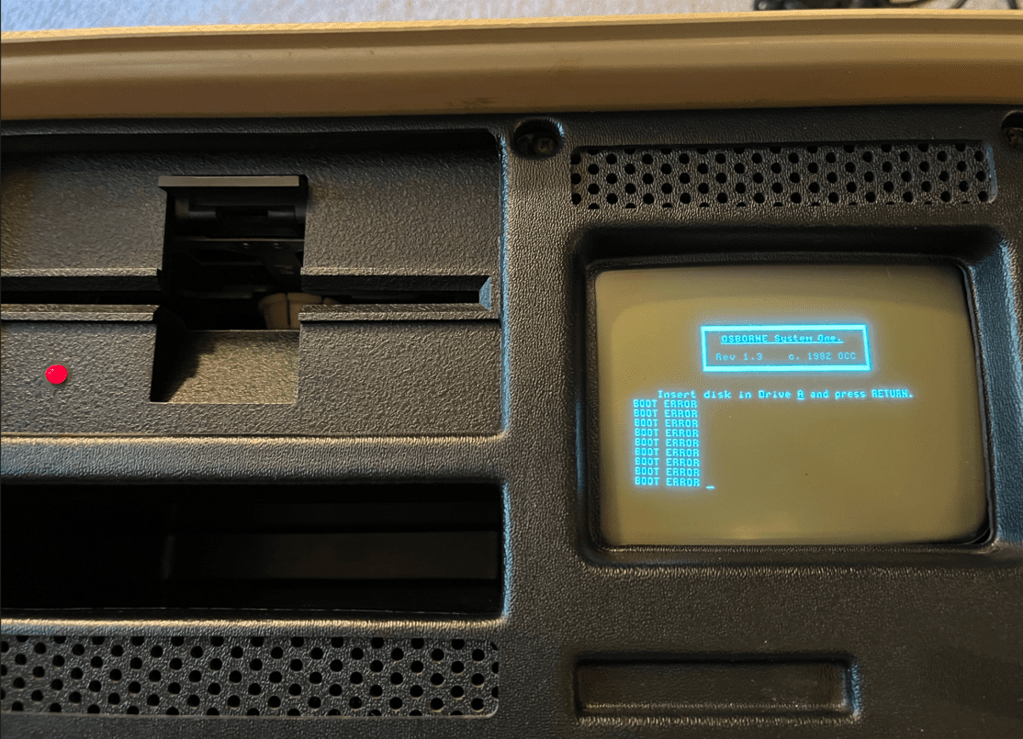
At this point I believe the machine is ready to boot from diskette, but I don’t own any to test with!
It appears that the only issue with the computer is the stuck keyboard, so I will probably leave that to the next enthusiast to debug and solve!

The construction is a bit flimsy but it is an otherwise attractive machine. I like it!
And I am also happy that I was able to use my MCLZ8 to quickly isolate the faulty DRAM out of the 32 possibilities.
 MicroCore Labs